
SOLIT² virtual fire test
Your nozzle system in the SOLIT² test gallery: Class A (a 150 MW HGV mock-up, covered) and Class B (diesel pools), at both airflow speeds of the protocol, with the activation time, ambient and fire growth the PMC sets.
For tunnel fire-safety and MEP teams, and the PMC who review them
SOLIT2 Simulator runs the SOLIT² virtual fire test for your water-mist system, checks the design against 85 clause rules, and gives your PMC a report they can read, with the evidence behind every number stated.
Request beta access See how it works
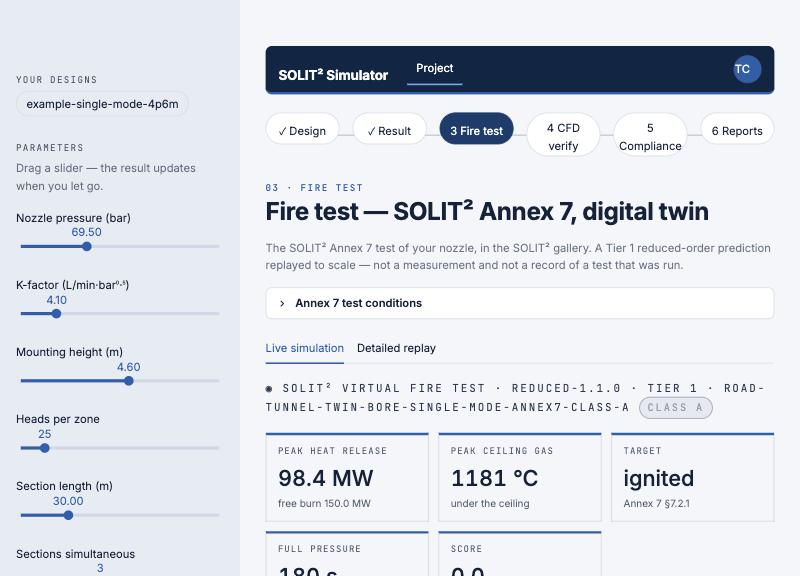
Whatever surprises a test holds, they arrive after the nozzles are chosen, the pipework is drawn and the PMC has asked for evidence. SOLIT2 Simulator moves the first look earlier: you see how your system is likely to behave in the SOLIT² test, which criteria it leans on, and which clauses still lack evidence, while the design can still change.
How it works
Enter the tunnel, the pipe network and pump, and the nozzle as the tester measured it. Nothing about the nozzle is assumed: a field left empty is reported as not set.
The SOLIT² virtual test runs for your system, over the worst cases of its envelope. You see heat release, temperatures, visibility and dose against the limits your authority set.
A clause-by-clause compliance check and a virtual fire test report for the PMC / Authority's Engineer, with what is evidenced, planned or only predicted kept apart.
What it does today
Your nozzle system in the SOLIT² test gallery: Class A (a 150 MW HGV mock-up, covered) and Class B (diesel pools), at both airflow speeds of the protocol, with the activation time, ambient and fire growth the PMC sets.
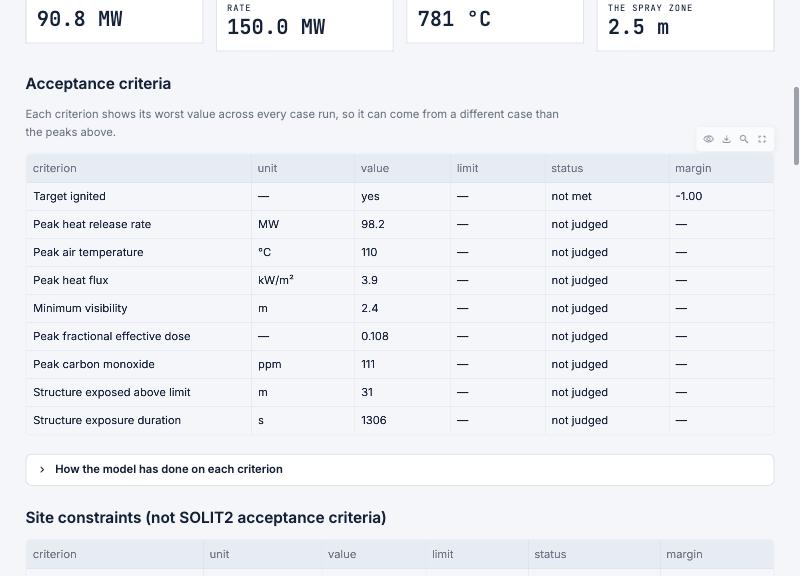
Limits come from the project's own authority. A criterion with no limit reads "not judged", never "passed", and a score appears only when every limit is set.
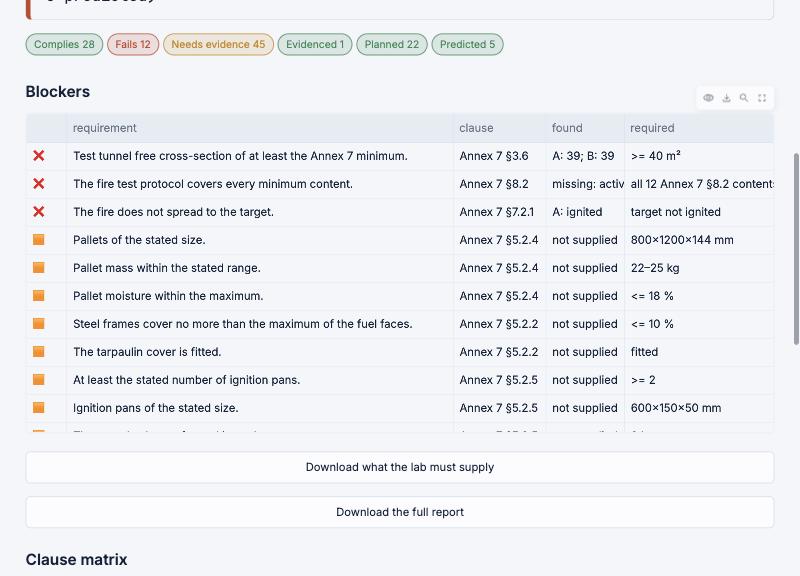
85 clause rules across the SOLIT² test protocol and a project rules file. Failing, evidenced and "needs evidence" are counted separately, and needs evidence is never counted as compliant.
A virtual fire test report with the issuer, the organisation and the issue time on every page. HTML, ready to print to PDF.
E0 (illustrative) to E4 (full-scale test), with the track record of the quantity behind each figure, so a reviewer sees how far to trust a number before relying on it.
Enter your own tunnel specification, hydraulic components and installed pump. The result shows pump pressure, losses, plant size and the pipe and valve take-off, not only the fire.
Where a reduced-order prediction is not enough, run FDS CFD on rented cloud machines and read the result beside the prediction. In beta: not yet generally available.
Every account is approved by hand and works in its own workspace. Team and admin accounts sign in with a second factor.
In the product
Screens show an illustrative example design at evidence level E0, not a real project.
Read this before you rely on it
Who it is for
Test a system choice and a layout against the SOLIT² test before the design is frozen, and see which criteria it leans on.
Size the plant to the tunnel you have: pump pressure, ring main and zone losses, tank, pumps, and the pipe and valve take-off.
Read one report that says what is evidenced, what is only planned or predicted, and what no limit has been set for.
CFD pricing
CFD runs on rented cloud machines, so its price follows the machine: the provider's hourly rate for the size you run, plus a service margin, quoted in US dollars. The rate is fixed when a job starts.
Beta pricing is shared at onboarding. No machine sizes or rates are published yet, and none are shown here until they are real.
Prices are in US dollars, plus applicable GST.
Beta programme
Questions
No. The engine is calibrated against published reference tests, not validated, and every result says so on screen. Treat each figure as a prediction until a full-scale test of your system exists.
No. It does not replace a full-scale test; it helps you reach one with a design that has been checked. The SOLIT² test protocol (§3.4) says CFD shall not replace full-scale testing.
Tier 1 is the reduced-order engine that runs a whole SOLIT² test in seconds. Tier 2 is CFD with FDS, run on demand and in beta. Where the two disagree, the disagreement is reported, not hidden.
Yours. The nozzle is entered by the tester and nothing about it is assumed. Where a value is an estimate rather than measured, the result says so and holds its evidence level down.
The SOLIT² virtual fire test, with clause checks against the protocol's requirements and a project rules file you supply.
The provider's hourly rate for the machine you run plus a service margin, in US dollars plus applicable GST, with the rate fixed when a job starts. Beta pricing is shared at onboarding.
No. SOLIT2 Simulator is a product of Darvish Consultants and is not affiliated with or endorsed by the SOLIT² project.